
What Is the Executor of an Estate in Tennessee?
Are you an estate beneficiary, or have you been named as the Tennessee executor of an estate and don’t know what the estate administration process involves or what steps you are expected to take?
This post explains who can serve as an executor, how the appointment process works, the powers and primary responsibilities that come with the role, and the common issues that may arise during estate administration.
What Is an Executor of an Estate in Tennessee?

In Tennessee, an estate executor is the individual or entity responsible for managing a deceased person’s legal and financial affairs after death. Also known as the estate’s personal representative, the executor is named by the deceased in the will.
Before acting on behalf of the estate, the executor is generally formally appointed by the probate court. Once appointed, the executor is responsible for carrying out the instructions in the will and complying with Tennessee probate law.
Executor vs. administrator: What’s the difference?
Even though both terms refer to a person who manages a deceased person’s estate, the difference lies in whether a will exists.
The estate administrator | The estate executor |
Is appointed by the probate court when the deceased didn’t leave a will. | Is nominated directly by the deceased in their will and then appointed by the Tennessee probate court. |
When distributing the decedent’s assets, estate administrators are expected to follow the Tennessee intestacy laws. | They distribute the estate assets in accordance with the decedent’s wishes expressed in the will and the state laws. |
They receive Letters of Administration. | They receive Letters of Testamentary. |
Who Can Serve as an Executor in Tennessee?
In Tennessee, any person may name any competent adult they trust to serve as their estate executor. Many people choose a spouse, an adult child, a sibling, a close friend, or another trusted individual. In some situations, a bank or trust company may also be named to serve as executor.
However, to be appointed by the probate court in this role, the nominated executor has to meet some basic criteria:
- Be at least 18 years old.
- Be mentally competent and capable of fulfilling their fiduciary duties and responsibilities.
- Be legally qualified – a person who is unsuitable because of misconduct, incapacity, or another legal reason may be denied appointment or removed after appointment.
- Be willing to accept the appointment as an executor and take the required oath before the probate court.
This is a list of the key criteria for being appointed as an estate executor, and it’s not exhaustive.
Can a beneficiary serve as executor?
It is common for a beneficiary to also serve as the estate’s executor, as holding both roles does not, by itself, create a conflict of interest.
However, the executor is required to act fairly and fulfill the fiduciary duties owed to all beneficiaries and other interested parties, in accordance with the will and Tennessee law.
Can an executor inherit from the estate?
In general, yes. Serving as an executor doesn’t prevent someone from inheriting under the will. It is common for an executor to also be a beneficiary, especially when the executor is the surviving spouse, an adult child, or another close family member.
However, when the executor is also a beneficiary of the deceased, the law requires them to be impartial and not use their position to gain an unfair advantage over the other beneficiaries.
Can an estate have more than one executor?
In many cases, the court may appoint two or more individuals as co-executors if the deceased named them in their will. They typically share the same authority and responsibilities and are expected to work together when making decisions on behalf of the estate.
However, as experienced probate lawyers, we do not recommend it. This may slow the administrative process if disagreements arise or documents require multiple signatures.
Can an out-of-state executor serve in Tennessee?
Yes. Tennessee law does not automatically prevent a person who lives outside the state from serving as an executor, but they are expected to meet all legal requirements and may need to take additional steps during the probate process.
If you have been appointed as an estate executor and live outside of the state, working with an experienced Tennessee probate attorney can help the administration proceed more efficiently.
How to Become an Executor of an Estate in Tennessee?
To become executor of an estate, one must be named executor in a will and complete the probate court’s appointment process.
How does the probate court appoint an executor? Probate Court appointment process.
To begin the Tennessee probate proceedings, the law requires the person who has the deceased’s original last will and testament to file it, along with a petition, with the probate court in the county where the decedent lived.
The court reviews the will, confirms its validity, and determines whether the person nominated as executor is qualified to serve.
If the court approves the appointment, the executor takes an oath to faithfully perform the duties of the office. Once these requirements are satisfied, the court authorizes the executor to administer the estate.
What are Letters of Testamentary?
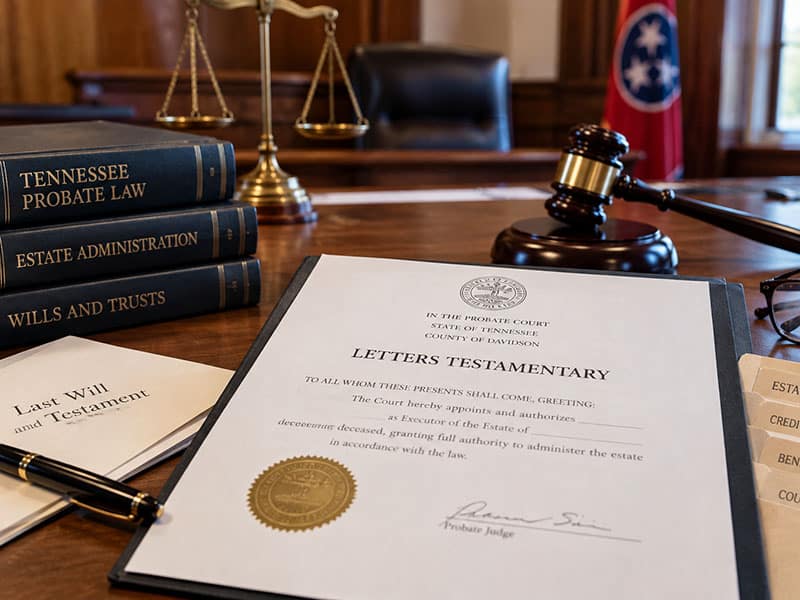
After the executor’s appointment is approved, the probate court issues Letters of Testamentary. This is the official document that grants the executor the legal authority to administer the estate.
Banks, financial institutions, government agencies, and others often may need a copy of the Letters of Testamentary before allowing the executor to access accounts, collect estate assets, sell property when authorized, pay debts, or complete other estate transactions.
What happens if the executor named in the will dies or cannot serve?
There may be situations when the named executor:
- Dies before being appointed by the probate court.
- Declines to accept the appointment.
- Resigns after the appointment has been made.
- Becomes mentally or physically unable to perform the required duties.
- Is legally disqualified from serving.
In some cases, the decedent has named an alternate or successor executor in their will who can step into the role if the first choice is unable to serve.
If the will does not designate a successor or if the alternate is also unable to act, the probate court may appoint another qualified person to administer the estate in accordance with Tennessee law.
Is a bond required?
Whether an executor posts a bond depends on the terms of the will and the circumstances of the estate. The court typically requires the executor to obtain one before issuing Letters of Testamentary, since it serves as financial insurance in the event the executor fails to perform their duties properly.
However, depending on the circumstances, the testator may expressly waive the bond requirement in their will.
Do All Wills Have to Be Probated in Tennessee?
The answer is It depends. Whether a will is admitted to probate depends on the circumstances of the estate.
In many cases, probate is necessary when the deceased owned assets that cannot be transferred without court involvement. If all assets pass directly to a surviving owner, a designated beneficiary, or a trust, formal probate may not be required.
In many cases, probate is required when the estate includes probate assets, such as:
- Real estate titled solely in the decedent’s name.
- Vehicles owned solely by the decedent.
- Bank accounts without a payable-on-death beneficiary.
- Other assets that do not transfer automatically upon death.
Probate may not be necessary when all the decedent’s assets are automatically transferred to a surviving owner or a designated beneficiary, or are held in a trust.
They are called non-probate assets and may include:
- Real estate owned by the deceased and their spouse as tenants by the entirety or as joint tenants with right of survivorship (JTWROS).
- Transfer-on-Death (TOD) brokerage or investment accounts.
- Annuities with a named beneficiary.
- Life insurance with a named beneficiary.
- Payable-on-Death (POD) bank accounts.
- Retirement accounts with a named beneficiary.
- Assets and properties held in a trust.
- Any other asset with a valid beneficiary designation.
In certain situations, Tennessee law also provides simplified procedures for smaller estates that meet statutory requirements.
What happens if someone dies without a will?
When a person dies intestate (without a valid will), the estate is administered under Tennessee’s intestate succession laws rather than the deceased’s final wishes.
What Are the Powers of an Executor in Tennessee?
An executor’s power is the legal authority granted to settle an estate. They allow the personal representative to:
- Administer the decedent’s estate.
- Protect its assets.
The scope of that authority depends on Tennessee law, the will’s document, and any orders issued by the probate court.
In general, an executor may be granted two types of power in Tennessee:
- Standard powers
- Generally include locating and protecting estate assets; accessing estate financial accounts; gathering records; communicating with known creditors; paying valid debts, medical bills, funeral costs, and other estate expenses; paying taxes; managing estate property; and distributing assets to beneficiaries as permitted by the will and applicable law.
- Expanded powers
- Allow the estate’s executor to take specific actions without obtaining prior court approval. Depending on the circumstances, these powers may be authorized by the will or granted by the probate court.
These are common examples of the powers that an estate executor may have, but they are not exhaustive. If you are an executor and need more information about the authority you need to administer a decedent’s estate, speaking with an experienced Tennessee probate attorney may help you better understand your options.
What Are the Responsibilities of an Executor in Tennessee?

While every estate is different, the executor’s role includes both fiduciary duties and responsibilities.
What are an executor’s fiduciary duties?
An executor serves as a fiduciary, meaning they are required to act in the best interests of the estate and the beneficiaries entitled to receive from it.
Some of the executor’s most important fiduciary duties include:
- Duty of loyalty:
- Put the estate’s interests ahead of personal interests and, whenever possible, avoid conflicts of interest.
- Duty of impartiality:
- The executor is expected to treat beneficiaries fairly and avoid favoring one beneficiary over another unless the will specifically indicates so.
- Duty of reasonable care:
- The executor is required to manage the estate with prudence and due diligence.
Failing to meet these duties can expose an executor to personal liability.
Gather and protect estate assets.
One of the executor’s first responsibilities is to identify, locate, and safeguard the estate’s assets. This may include, but is not limited to:
- Securing real estate property.
- Collecting financial accounts.
- Protecting valuable personal property.
- Ensuring that estate assets are not lost, damaged, or improperly transferred during probate.
Notifying beneficiaries and creditors.
Under Tennessee law, the executor is responsible for
- Notifying beneficiaries that the estate is open.
- Providing notice to creditors and giving them an opportunity to present valid claims against the decedent’s estate within the time allowed by law.
Preparing the estate inventory.
The executor may be required to identify and value the estate’s probate assets.
Preparing a complete and accurate inventory helps establish what property belongs to the estate and provides the probate court and interested parties with a clear record of the estate’s assets.
Pay debts, taxes, and administration expenses.
Before distributing any property to the designated beneficiaries, the estate’s personal representative pays the deceased’s outstanding debts, estate expenses, and taxes from available estate assets.
When the estate funds are insufficient, the executor may need to sell estate property at its fair market value, including real estate, if permitted by Tennessee law or approved by the probate court.
Distribute estate assets according to the will.
After paying all the outstanding debts and expenses, the executor typically distributes the remaining property to the beneficiaries designated in the will.
Every asset distribution is expected to follow the terms of the will and any applicable court orders.
Keep accurate financial records and accounting.
Throughout the probate process, the executor is expected to maintain complete and detailed records of all estate transactions.
This way, they may demonstrate that estate assets were properly managed and provide an accounting to the probate court or beneficiaries when required.
Close the estate.
Once all required tasks have been completed, the executor asks the probate court to close the estate and discharge them from the role.
Before closing the estate, the executor typically demonstrates that the estate has been fully administered, that all required payments have been made, and that the remaining assets have been properly distributed to the designated beneficiaries.
What Can an Executor Not Do?
Although an executor has broad authority to administer an estate, that authority has legal limits. The executor is typically expected to follow the terms of the will, comply with Tennessee law, and always act in the estate’s best interests.
However, the estate’s personal representative also has limitations:
- They don’t have the authority to change beneficiaries or alter the share of any other party, regardless of whether they are a member of the Tennessee families or another entity. If the deceased left a valid last will and testament, the executor is usually expected to follow it when distributing the assets to the designated beneficiaries.
- The estate’s personal representative cannot favor one beneficiary over another unless the will specifically says so.
- An executor generally cannot distribute estate assets until valid debts, taxes, and administration expenses are paid. Making distributions too early may leave the estate unable to satisfy its obligations and could expose the executor to personal liability.
- They can’t use estate property for personal benefit. Misusing estate property may lead to removal by the probate court and other legal consequences
How Long Does an Executor Have to Settle an Estate in Tennessee?

There is no fixed deadline for an executor to complete probate in Tennessee. However, the entire timeline depends on the types of assets in the estate, the estate’s size, and whether any disputes or creditor issues arise.
Although every estate is different, the timeline usually includes the following strict deadlines:
- Within 30 days after learning of the death, the will is expected to be filed with the probate court.
- Within 4 months after the first publication of the Notice to Creditors in a local newspaper, they are expected to file their claims against the estate.
- Executors are expected to file an inventory of estate assets within 60 days of appointment.
- Within 30 days after the creditor claim period ends, the executor or another interested party may object to any creditor claims filed on time.
Multiple factors may extend the probate timeline, including:
- The size of the estate and its complexity.
- Will contests or beneficiary disputes.
- Creditor claims or tax issues.
- Difficulty in locating, valuing, or selling assets.
- Missing heirs or beneficiaries.
- Litigation involving the estate.
While many Tennessee estates are settled within several months to about a year, more complex estates may take significantly longer.
How Much Does an Executor of an Estate Get Paid in Tennessee?
Tennessee law does not set a fixed fee for executors. However, an executor is generally entitled to reasonable compensation based on the work performed, the estate’s complexity, and the time involved.
A will may specify the executor’s compensation or eliminate it completely. If necessary, the probate court may review and approve the amount.
In addition to compensation, an executor is generally entitled to reimbursement for reasonable expenses incurred while administering the estate. An executor may also choose to waive compensation, which is common when they are also a family member of the deceased.
What Can Cause Problems for an Executor?
Even a well-intentioned executor can face legal or financial problems if the estate is not administered properly.
Common mistakes may include, but are not limited to:
- Distributing assets before paying valid debts and taxes.
- Failing to keep accurate records.
- Missing probate deadlines.
- Failing to follow the will’s terms or Tennessee law.
When disputes arise between beneficiaries, they may also delay the probate process and increase the executor’s risk of personal liability.
This is a list of the most common problems an estate executor may face, but it is not extensive. If you are facing an issue in administering a decedent’s property, speaking with a probate attorney may help you understand your options and the following step.
Can an Executor Be Removed in Tennessee?
Yes, a Tennessee probate court may remove an executor who fails to properly administer the estate.
Common grounds for removal include, but are not limited to:
- Breaching fiduciary duties.
- Mismanaging or misusing estate assets.
- Failing to perform required duties.
- Disregarding court orders.
- Causing unreasonable delays.
A beneficiary, heir, creditor, or another interested party may ask the court to remove the executor. If removal is ordered, the court appoints a qualified successor, and the former executor may be held personally liable for losses caused to the estate.
The Next Step.
Being appointed as an estate executor in Tennessee often involves important legal decisions, strict deadlines, and responsibilities that may affect both the estate and its beneficiaries.
If you have questions about your rights or responsibilities, obtaining legal guidance early can make the process less time-consuming and more manageable.
Contact our office at (629) 240-7760 or schedule a consultation to speak with one of our team members, who may help you better understand your legal obligations and confidently fulfill your role as a Tennessee executor of an estate.